
Author: Jhilmil Rathore (Student Volunteer) | 22nd November 2025

I’ll be honest. I use ChatGPT to refine, research, and refresh my knowledge on different matters. I may even use it to correct the grammar of this blog once I’m done with the final draft. I don’t think that’s wrong. Tools that make us more efficient aren’t the enemy. But sometimes I wonder what we are losing in exchange.
Journalist Leher Kala recently wrote a piece in The Indian Express about “what we lose to AI.” One line stayed with me—she said we are losing the very process of thinking. And it’s true. We’ve grown so used to outsourcing that struggle—the pauses, the scribbles, the half-baked ideas—that we’ve almost forgotten what it feels like to sit with a thought and work it out ourselves.

The other day I watched a short reel by a content creator who usually makes funny skits, but this time she just asked: “What happened to having a think?” It sounds simple, but it hit me. What did happen to just… thinking? Not scrolling, not Googling, not prompting, but actually thinking. Sitting with a question, turning it over in your head, connecting it to what you’ve read, what you’ve seen, what you believe.
When was the last time we did that?
For many people, the answers they “believe” today are shaped by the people they follow online, the pages they subscribe to, and the voices they hear in their circle. Social media has created an endless loop where opinions are recycled until they feel like original thought. But are they? Or are they just convenient stand-ins for the work of building a belief system of their own?
That’s what unsettles me. Not just that AI gives us fast answers, but that we’ve stopped questioning the answers we’re given—whether from algorithms, influencers, friends, or family. What happened to building an opinion from scratch, with our own schemas and lived experiences?
It’s not just about abstract topics like politics or philosophy. It shows up in everyday life too—how we notice challenges or inconveniences in daily life, but do we ever pause to really think about why they exist or what shapes them? Or do we just echo what’s already been said loudly enough around us?
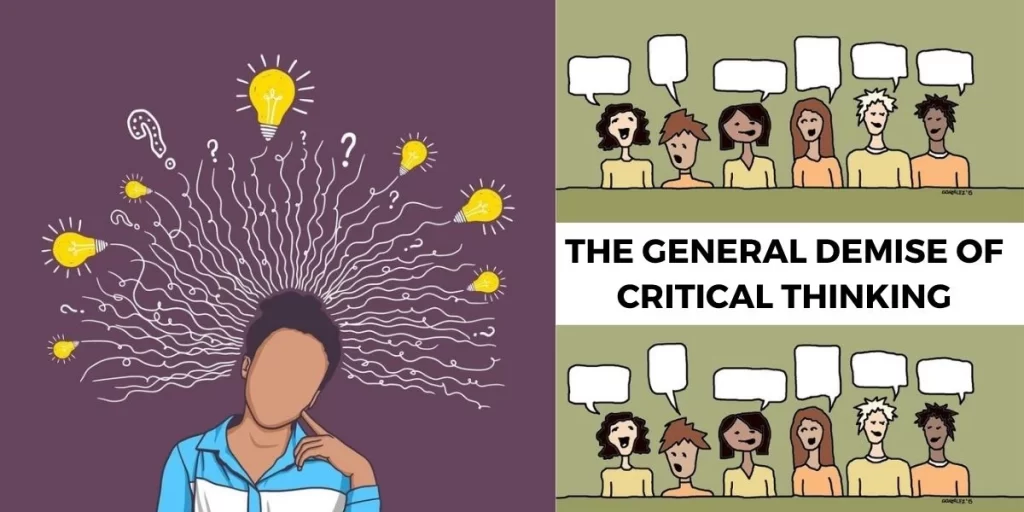
All of this makes me feel that what we’re losing to AI is more than just critical thinking. Yes, that’s the core of it, but critical thinking ties into everything else: our ability to form independent beliefs, to ask uncomfortable questions, and to not just accept the world as it is handed to us. Without that, we risk becoming passive consumers—efficient, maybe, but shallow.
I don’t have neat answers. This blog isn’t meant to give them. It’s more of me wondering out loud, noticing the ways in which I too have let tools and timelines take over the harder work of thinking. I’m writing this as much for myself as for anyone reading it, because I notice how easily I too reach for a quick answer instead of wrestling with an idea. Maybe the bigger question is not what AI is doing to us, but what we are allowing ourselves to become in its presence.
So I return to that reel, that deceptively simple question: what happened to having a think?
Maybe the first step is to remember what that feels like again.
When we lose the habit of thinking for ourselves, we also lose the foundation of our belief systems. A belief system is not just a set of opinions—it’s the inner framework we use to make sense of the world. It comes from reflection, lived experiences, reading, mistakes, and conversations that challenge us. But today, many people are building their “beliefs” on ready-made content: a viral post, a trending video, an AI-generated summary. These are borrowed fragments, not the slow, stitched-together fabric of thought.
AI and social media make it worse because they don’t just give us information—they give us the most convenient version of it. AI packages complex ideas into neat, polished responses. Social media feeds us whatever aligns with our past clicks. Over time, people stop reaching beyond what’s served to them. Their brains get trained to consume instead of wrestle, to absorb instead of analyse.
And when that happens, conversations lose depth. How often do discussions now sound like repeated headlines or simplified takes? We rarely hear, “I sat with this idea, and here’s what I think.” Instead, we hear, “I saw this video…” or “I read somewhere that…” The difference is subtle but significant. One comes from personal processing, the other from repeating what was already processed for you.
The danger isn’t just laziness—it’s erosion. Erosion of independent thought, curiosity, and the discomfort that comes with sitting in uncertainty until clarity forms. Without that, belief systems become fragile. They shift with trends, sway with algorithms, and lean on whatever voice shouts the loudest.

And this isn’t just about big issues. It’s in the small things too—choosing what’s worth your time, deciding what feels right for your own life, even how you interpret everyday events. If we don’t practice critical thinking here, we risk losing the mental muscle entirely.
Efficiency matters. But if it comes at the cost of depth, if it costs the slow labour of building our own perspective, then what are we really efficient for? To echo the thoughts of others? To fill silence with answers that aren’t ours? That doesn’t feel like living meaningfully.
Critical thinking is not optional. It is the act of being present with our own minds. And AI and social media, for all their benefits, are quietly training people to bypass it. If we let them, we lose more than just thought—we lose ourselves.
Maybe the next time you reach for an easy answer, pause. Sit with the question instead. Let your mind wander, connect the dots, argue with yourself. Notice what feels right, what doesn’t, and what surprises you. It won’t be fast or convenient, but it will be yours. In a world where convenience is everywhere, taking the time to think—really think—is the quietest form of resistance, and perhaps the most human act we still have.
Reference: Kala, Leher. (2025, September 8). “What We Lose to AI.” The Indian Express.